7 APR 2020
Hi, my name is Jiří Šilha and I am a researcher at the Faculty of Mathematics, Physics and Informatics, Comenius University in Bratislava, Slovakia. My primary research topic is the space debris. In June and July 2019, I spent two weeks at the Instituto de Astrofísica de Canarias (IAC) where I was hosted by the IAC research coordinator Dr. Javier Licandro. My primary task was to establish active collaboration with the IAC and to discuss different ways how to include students to the mutual science projects trough the ERAZMUS+ program.
During my first week at IAC I gave a talk to the researchers involved in Near Earth Asteroids and space debris observations. Talk was dedicated to the space debris research at my university and it can be watched here: https://www.youtube.com/watch?v=-sBNPoITSHo
During my visit I got several meetings with the IAC colleagues to discuss in detail realization of our collaboration. I was introduced to data planning/scheduling, acquisition and processing of space debris observations with the IAC80 telescope and I got a tour of the laboratory, where the tests of new CCD and CMOS cameras are taking place before they are installed on the telescopes. Most impressive were the tours of observatories, where I could see the telescopes themselves.
My trip to IAC also covered small service missions to our All-sky Meteor Orbit System (AMOS) cameras. AMOS cameras are installed on Teide observatory (Tenerife island) and on Roque de los Muchachos Observatory (La Palma island) and they are good exemplary cases of international scientific cooperation.
Mission to Teide observatory

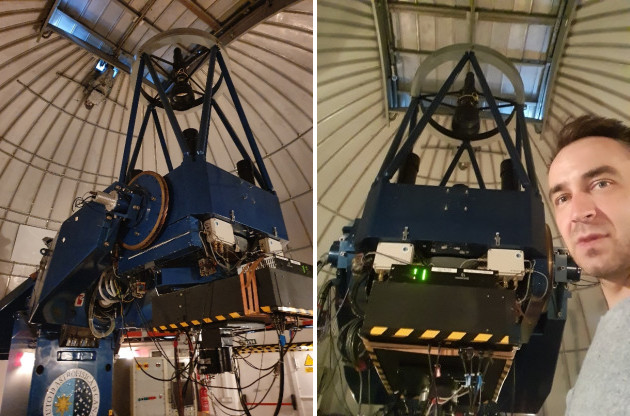
My mission to Teide observatory started with AMOS camera service. Thanks to the great guide Dr. Licandro, I was able to have a closer look on the some of the Teide observatory’s telescopes. Quite close to our AMOS camera is a dome which hosts 1.52-m Telescopio Carlos Sánchez. This system is equipped with four-color simultaneous camera able to perform exoplanet transit photometry in four filters, g, r, i, and zs bands by using MuSCAT2 instrument. Telescope is almost 50 years old but still operational.
The highlight for me was the first time visit of the space debris research flagship, the European Space Agency’s (ESA) Optical Ground Station (OGS). I used to plan and process observations from this telescope some time ago when I was a researcher at the Astronomical Institute of University of Bern but I never had the chance to see it in person. OGS is a Ritchey-Chretien telescope on the equatorial English/Yoke mount with 1-meter primary mirror. System is continuously used for almost two decades to survey space debris population in geostationary ring and to search for Near-Earth Asteroids (NEA).
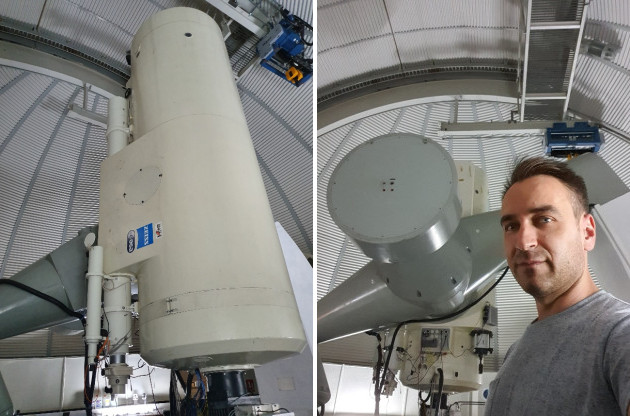
The IAC80 telescope, placed not far from OGS and Telescopio Carlos Sánchez, was designed and built fully by the Instituto de Astrofísica de Canarias. It is a Cassegrain design telescope on equatorial mount. System is dedicated to wide range of topics with primary focus on photometry and spectroscopy and from time to time it also acquires astrometric measurements of space debris.
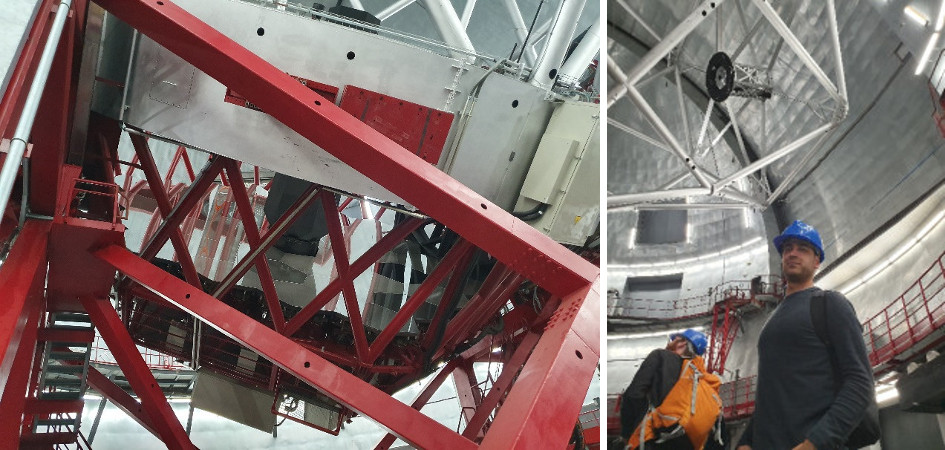
For the mission to Roque de los Muchachos Observatory I was joined by two of my colleagues. We got a great opportunity to have a closer look on the Gran Telescopio CANARIAS (GTC), the largest single aperture telescope on the world with 10.4-meter primary mirror. The tour was given by very kind support astronomer who had the shift that night. We did visit the control room, as well the dome. We got surprised by the size of the system, as well by its complexity. The open metal construction is dominant in the dome and the primary mirror consisting from 36 hexagonal segments supported by the active optics mechanism is wide open and visible to any visitor. The instrument is of size of a smaller car, which is something not often to see.
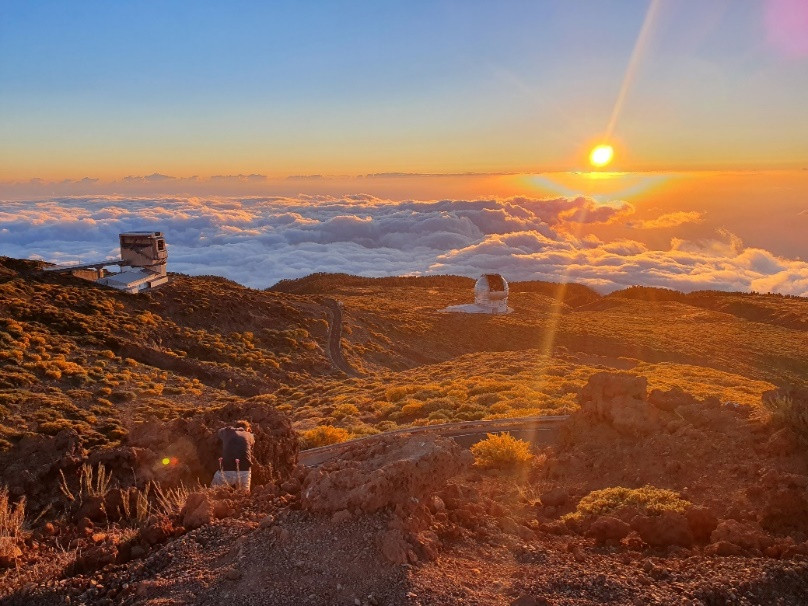
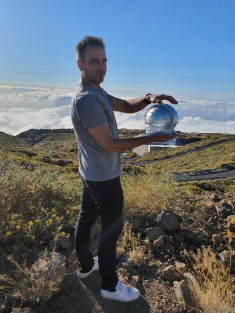
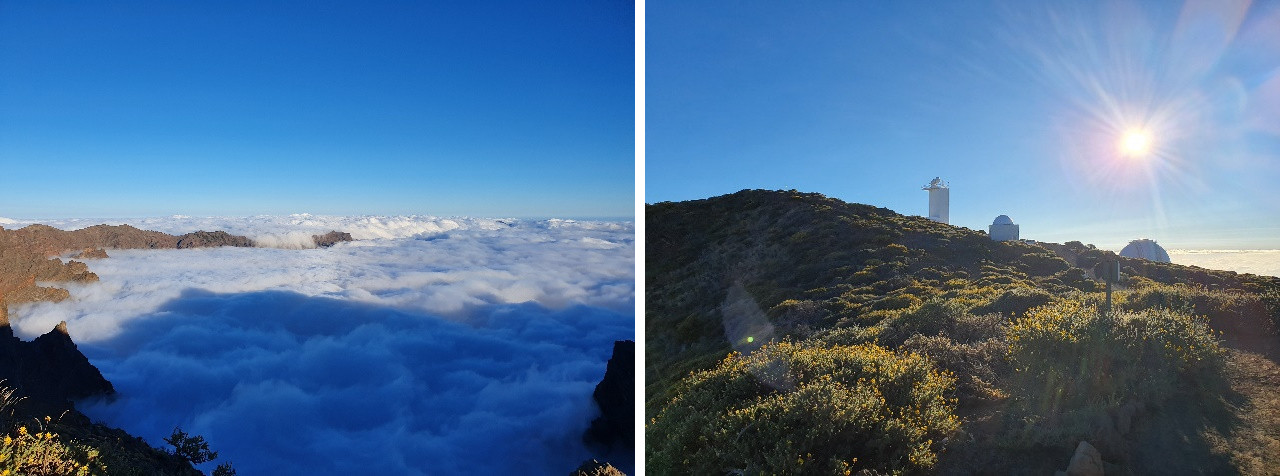
After the GTC tour we had some tome to walk around the observatory, the scenery is breathtaking wherever you look.
Thanks to the good timing, we were able to capture the sunset from the height of more than 2300 meter above the sea level. No need to have professional equipment.
My visit of IAC ended with a mutual agreement to collaborate in area of space debris and NEA data acquisition, data processing and project preparation with primary focus on European Space Agency’s and European Horizon programs.
Jiří Šilha, Faculty of Mathematics, Physics and Informatics, Comenius University in Bratislava, Slovakia